Your garage hits 115 degrees by 3 p.m., the AC in the house can’t reach it, and you’re tired of sweating through workouts, projects, or just grabbing something from the freezer. So you start shopping for a mini split, punch your square footage into an online calculator, and get a number that feels too small. Trust that gut feeling. Garages break almost every normal sizing rule, and in North Texas they break them harder.
Quick answer: Most garages need a mini split between 9,000 and 24,000 BTU. A one-car garage usually lands at 9,000 to 12,000 BTU, a two-car garage at 12,000 to 18,000 BTU, and a three-car garage at 18,000 to 24,000 BTU. In DFW, plan on the higher end of each range because of our heat, weak garage insulation, and west-facing doors. The only way to lock in the exact number is a load calculation done by a licensed pro.
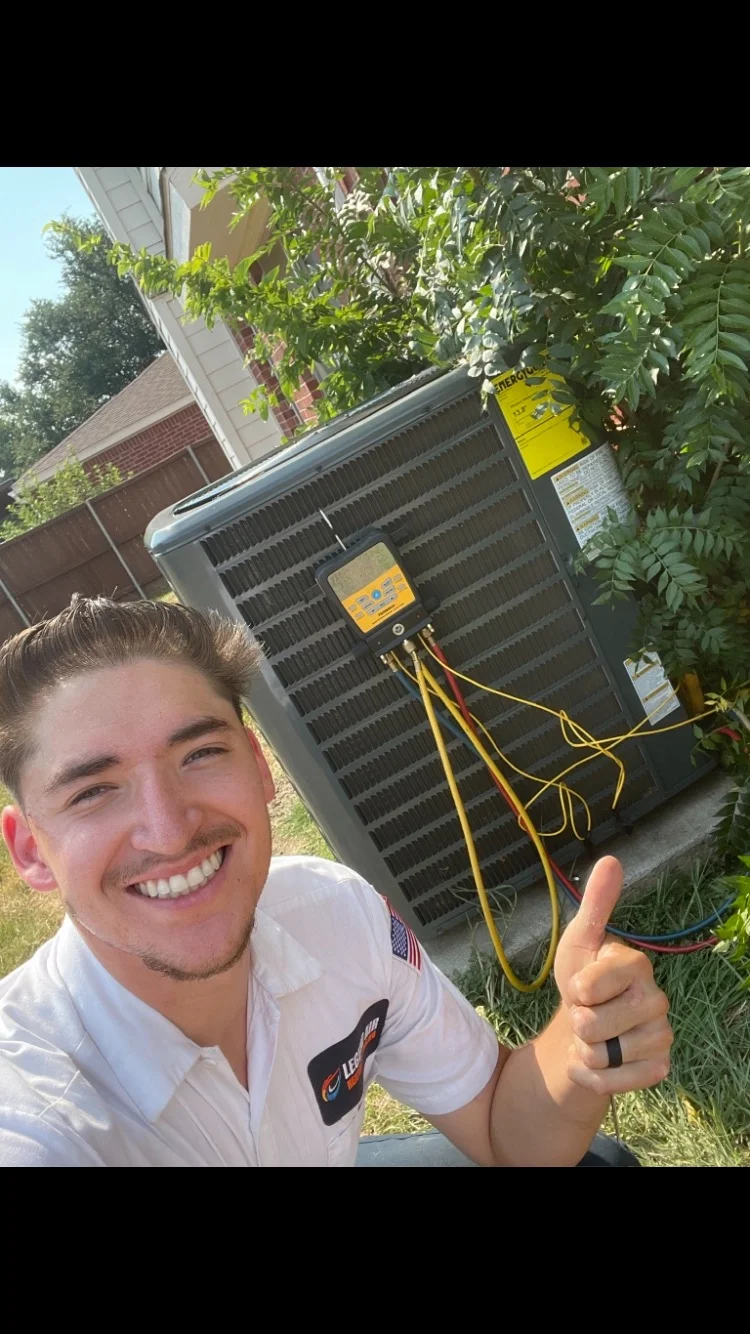
We’re Legend Air Conditioning & Heating, a family-owned team based in Frisco that has serviced the Dallas Fort Worth area since 2001. We deal with these superheated garages every summer, so if you’re weighing a new AC installation in Frisco, this guide walks you through the real math before anyone quotes you a system.
Why the Standard BTU Formula Fails in a Garage
The common rule of thumb is 20 to 25 BTU per square foot for an average room. That works fine for a bedroom. Drop it in a garage and you’ll undersize badly.
Here’s why. Most garages stack three problems at once: little or no insulation (and garage doors are terrible thermal barriers), a concrete slab that soaks up heat all day and releases it slowly, and a big door facing south or west that catches hours of direct afternoon sun.
AC Direct shared a real example that makes the point. A 450 square foot garage sized with the basic 20 BTU formula came out to 9,000 BTU. That unit ran nonstop and never hit its target temperature. The correct capacity turned out to be 18,000 BTU, double the formula’s answer.
So for garages, the working range looks more like this:
- 25 to 30 BTU/sq ft if the walls and garage door are insulated
- 30 to 35 BTU/sq ft for average insulation and occasional use
- 35 to 40+ BTU/sq ft if the door opens often (and you should think about stepping up a size)
BTU Ranges by Garage Size
Use this as a starting point, not a final answer. Ceiling height, insulation, sun load, humidity, and how you use the space all move the number.
| Garage Type | Typical Size | Common BTU Range | DFW Reality Check |
| One-car | Up to ~400 sq ft | 9,000 – 12,000 BTU | Lean toward 12,000 if the door faces west |
| Two-car | 400 – 600 sq ft | 12,000 – 18,000 BTU | 18,000 is common for uninsulated builds |
| Three-car | 600 – 800 sq ft | 18,000 – 24,000 BTU | May need 24,000+ with high ceilings |
Mini split indoor heads are usually sold in 9K, 12K, 18K, 24K, and 36K sizes. A garage or workshop with lots of exposure often needs the 18,000 BTU head where a normal 500 to 600 square foot room would be fine with 12,000.
Once you know the size range your garage needs, compare specific models in our garage AC buyer’s guide before you buy.
The Factors a Pro Adds to Your Garage’s Load
A real load calculation adjusts the base number for the things your garage actually has going on. These are the inputs a technician measures, not DIY projects:
- Poor or missing insulation: can push the BTU need up 30 to 50 percent
- Ceilings above 8 to 10 feet: add 10 to 30 percent for the extra air volume
- Heat-making hobbies like welding or woodworking: add 25 to 35 percent
- People and recent car heat: roughly 400 BTU per person, plus 10 to 20 percent for a car that just pulled in or sun through windows
- West or south-facing doors: steel doors soak up and hold more heat than wood or composite
That people’s math surprises folks. If you run a garage gym class of 15, that’s about 6,000 BTU of body heat alone, enough to push a 12,000 BTU space into 18,000 BTU territory.
One more thing worth knowing: mini splits run most efficiently when they hold a steady temperature low and slow. A garage you only use now and then, with the system off in between, may need to be sized up so it can recover fast when you flip it back on.
Why DFW Garages Are a Special Case
An uninsulated garage runs 10 to 18 degrees hotter than the outside air on a sunny day. On a 95-degree afternoon, that’s a 110 to 115 degree garage. Texas can push it further. E.J. Nadolny, CEO of Canopy Insurance Texas, has noted that the inside of a non-ventilated Texas garage routinely reaches 130 to 140 degrees.
Our heat load isn’t a one-week problem either. Per the National Weather Service, DFW normally sees about 20 triple-digit days a year. But 2023 brought 55 days at or above 100, 2011 set the record at 71, and the all-time high of 113 degrees was recorded in 1980. Some years surprise us the other way. 2025 had only six 100-degree days, all crammed into late July.
The lesson from that swing is simple: don’t size your unit for a mild summer. A garage system that barely coped in 2025 would have drowned in 2023.
West-facing doors take the worst of it. They get slammed in the 3 to 6 p.m. window, which is exactly when DFW outdoor temps peak. If your garage faces west, that’s a strong reason to build in extra capacity.
Bigger Isn’t Better: What Happens When the Size Is Wrong
A lot of homeowners assume more BTUs means more comfort. It doesn’t. The right unit pulls the temperature down without short cycling, wrings out humidity, and holds comfort steadily.
| Problem | What You’ll Notice | Why It Happens |
| Undersized | Runs nonstop, never reaches setpoint | Can’t keep up with the heat load; wears out faster |
| Oversized | Room feels cool but damp and clammy | Cools too fast to pull moisture out of the air |
The humidity issue is real science. The EPA’s ENERGY STAR program explains that an AC has to run long enough for moisture to condense on the coils and drain away. Oversized units short cycle, which lets that moisture evaporate back into the room and can invite mold. Efficiency also climbs the longer a unit runs. Stretching a cycle from 5 to 9 minutes improves efficiency by about 17 percent.
Building scientist Allison A. Bailes III, PhD, founder of Energy Vanguard, put the whole rule-of-thumb problem plainly:
“Rules of thumb must die. Start with a real load calculation.”
He backs it with data. Across 40 Manual J load calculations in hot and mixed climates, the results averaged 1,431 square feet per ton but ranged all the way from 624 to 3,325 square feet per ton. That spread is why no square-footage shortcut can replace an actual calculation. Bailes also notes that variable-capacity inverter mini splits tolerate a little oversizing, since they can ramp down, but only within the equipment’s turndown limits.
What’s Different About Installing a Mini Split in 2026
A few things changed recently that affect any new garage install in DFW.
New refrigerant rules. Under the EPA’s AIM Act, manufacturers stopped making residential HVAC equipment using R-410A as of January 1, 2025. As of January 1, 2026, new installs must use a refrigerant with a GWP of 700 or less. So your new garage mini split will use an A2L refrigerant like R-454B (GWP 466) or R-32. These come with added safety features like leak detection and are considered safe for home use when installed to code by a licensed contractor. Good news if you already own an R-410A system: you can keep servicing, repairing, and recharging it.
A tax credit correction. The federal Section 25C credit that offered up to $2,000 for heat pumps expired December 31, 2025. Heat pumps installed in 2026 or later don’t qualify, so ignore older articles claiming it runs through 2032. If you want to save, ask a local pro about current utility rebates instead.
Texas licensing and permits. In Texas, anyone installing HVAC equipment must hold a TDLR license, and a mechanical permit is typically required with an inspection before the system runs. Unlicensed work can bring fines of $500 to $5,000 per violation, and unpermitted installs can void your homeowner’s insurance and your manufacturer’s warranty. That alone is a strong reason to skip DIY kits for a garage this hot.
The Legend Air Garage Load Check
Because garage loads vary so widely, we don’t guess. Our Garage Load Check looks at the five things that actually drive your number:
- Envelope (insulation on walls, ceiling, and door)
- Door orientation (north, south, east, or that brutal west)
- Ceiling volume (height and total air to cool)
- Slab and solar gain (heat stored in concrete and pouring through the door)
- Usage pattern (daily gym, weekend workshop, or occasional use)
That review feeds a Manual J calculation, which is the same method the U.S. Department of Energy recommends on every job. From there we match the right head size and hand you a clear recommendation with an upfront quote, no pressure attached.
Want a number you can actually trust for your garage? Reach out to Legend Air Conditioning & Heating for a free Garage Load Check. We’ll size it right the first time so you’re not paying for a unit that’s too small to keep up or too big to stay comfortable.
Frequently Asked Questions
What size mini split do I need for a 2-car garage in Texas? Most two-car garages need 12,000 to 18,000 BTU. In DFW, uninsulated garages often land at 18,000 because of our heat and leaky doors. A load calculation confirms the exact figure.
Is 12,000 BTU enough for a 2-car garage? Sometimes, if the garage is well insulated and used lightly. If it’s uninsulated, has a west-facing door, or you use it a lot, you’ll likely need 18,000 BTU to keep up.
Why does my garage mini split run constantly and never cool down? That’s the classic sign of an undersized unit. It can’t match the heat load, so it runs nonstop and still misses the target. Resizing based on a real calculation usually fixes it.
Why do online mini split calculators get garage sizing wrong? They use the standard 20 to 25 BTU per square foot formula built for insulated rooms. Garages have poor insulation, concrete slabs, and sun-baked doors, which the basic formula ignores.
Should I insulate my garage before installing a mini split? It often helps. Carrier Enterprise notes that adding insulation first can let you use a smaller unit and save on energy bills versus buying a bigger system. Ask your installer to weigh both options.
Do I need a permit to install a mini split in Frisco? Yes. A mechanical permit and a TDLR-licensed contractor are typically required in Texas, with an inspection before the system runs. Skipping this can void your insurance and warranty.
What refrigerant do new mini splits use in 2026? New systems use lower-impact A2L refrigerants like R-454B or R-32 to meet current EPA rules. Existing R-410A systems can still be serviced and recharged.