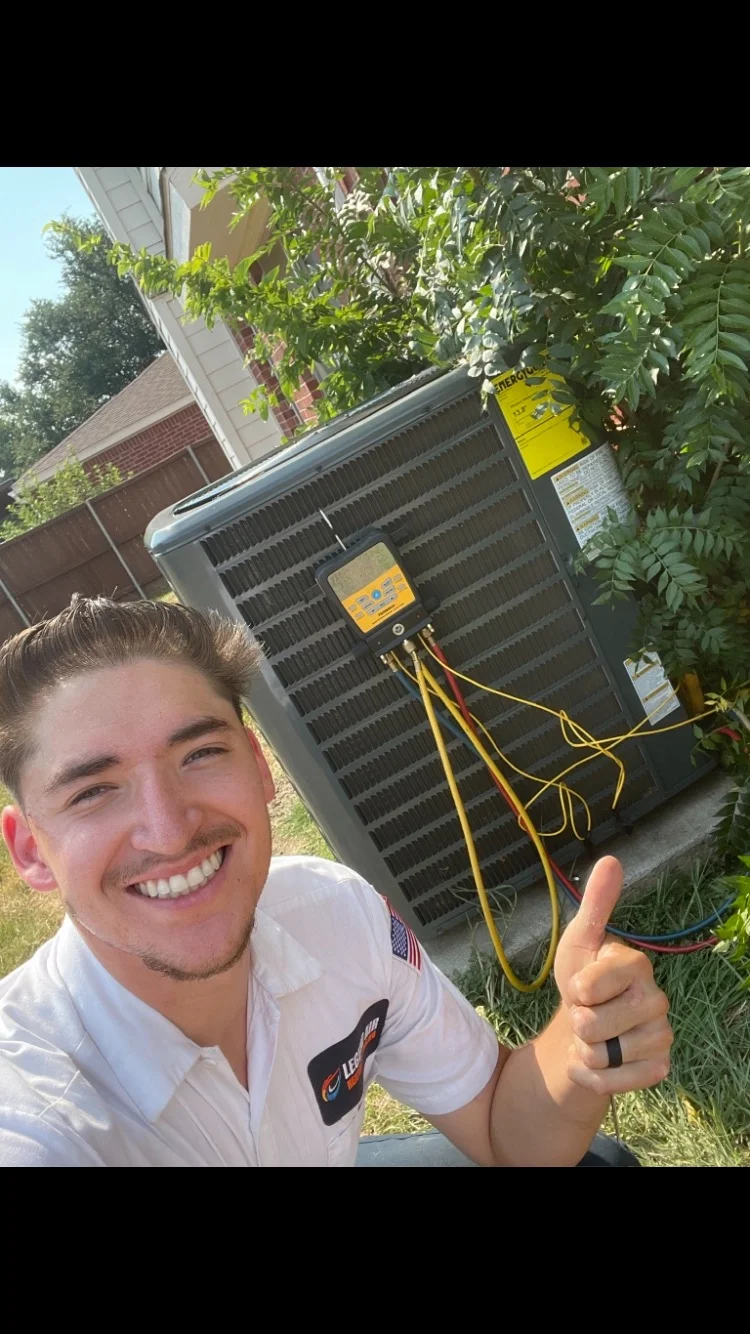
Here’s something most homeowners in Frisco never get told: shading your outdoor AC unit the wrong way can make it run hotter, not cooler. The metal cabinet baking in the sun isn’t the real threat. The trouble starts when a cover, a structure, or the wrong plant blocks the air your unit needs to breathe.
In the Dallas Fort Worth area, that mistake shows up at the worst possible time. We average around 20 triple-digit days a year, and a condenser that can’t move air will struggle on the exact afternoon you’re counting on it most. So if you’ve been planning to toss a tarp or a lid over your unit before summer peaks, read this first. If your system is already short-cycling or blowing warm, skip the experiments and book HVAC service in Frisco, TX so a technician can look at it.
By the time you finish, you’ll know the difference between shade that actually protects your system and “protection” that quietly wears it down.
Does Shading Your AC Unit Actually Keep It Cooler?
Barely. Airflow matters far more than sun on the cabinet.
Researchers at the Florida Solar Energy Center (FSEC), in a study by Parker, Barkaszi, and Sonne titled “Measured Impacts of Air Conditioner Condenser Shading,” found roughly a 1.2% efficiency gain for every 1°F drop in the temperature of air entering the condenser. Even in a good scenario, total savings came in under 3%. A separate 2010 study from the Kuwait Institute for Scientific Research concluded the benefit of shading the unit isn’t expected to top about 1%.
Why so small? The condenser (the outdoor box that releases heat from your home) moves a huge amount of air. A typical 3-ton unit pulls about 2,800 cubic feet per minute, which works out to roughly 168,000 cubic feet every hour. That’s close to three times the air volume inside an average house. No small shade can cool that much moving air, so the metal getting warm just doesn’t move the needle much.
Why is Shading Your AC the Wrong Way Worse Than No Shade?
Because most condensers blow hot air straight out the top. Anything that traps that rising heat forces the unit to breathe its own exhaust back in.
Many residential units are top-discharge, meaning the fan pushes hot air upward. Cover that top with a lid, a board, or a low structure, and the hot plume stagnates and recirculates. That raises the temperature of the air going back into the coil, which raises head pressure inside the system. Higher head pressure means the compressor works harder, runs hotter, and wears out faster.
This is the part most homeowners never hear. The shade feels protective, but it’s slowly choking the system.
| What you do | What actually happens |
| Cover the top of the unit | Hot exhaust gets trapped and recirculated, raising coil and compressor temperature |
| Box it in on all sides | Airflow drops, head pressure climbs, capacity falls |
| Filter sunlight from a distance | Mild benefit, no airflow penalty |
| Shade the yard and home instead | Cools the ambient air the unit breathes, the bigger lever |
How Much Clearance Does an AC Condenser Need for Airflow?
Enough to breathe freely. A common starting point is about 24 inches of clear space around the sides, with more room at the service panel and overhead. But your unit’s installation manual sets the real number, and some require far more.
Here are figures that show up across manufacturer guidance:
| Area around the unit | Typical clearance |
| Sides | 12 to 24 inches |
| Rear | About 24 inches |
| Front / service side | About 36 inches |
| Above the unit | About 60 inches (5 feet) |
Treat these as a floor, not a target. Check your own manual or have an installer confirm it, because some models need significantly more space.
The stakes are real. When coil airflow is restricted, head pressure and operating temperature climb, cooling capacity drops, energy bills rise, and compressor life shrinks. None of that announces itself until a hot afternoon when the system can’t keep up.
Does Painting Your Outdoor AC Unit Void the Warranty?
Usually yes, and paint on the coil fins is worse than a paperwork problem. Paint clogs the thin metal fins, blocks airflow, and can cause overheating.
Manufacturer warranties cover defects in materials and workmanship. Owner modifications that affect performance generally aren’t covered. The Magnuson-Moss Warranty Act, the federal law governing consumer product warranties, allows a limited warranty to be voided when a change significantly affects performance. Paint that leads to chipping, rust, or malfunction falls on the owner.
So the honest answer splits two ways. Painting the coils is clearly harmful and not worth it. Painting the outer cabinet is a warranty-terms question, so confirm it with your manufacturer or installer before you touch a brush.
If you’re unsure whether a past modification affected your system, a quick professional AC maintenance visit can confirm whether airflow and coil temperature still read normal.
Can a Patio Umbrella or Shade Structure Damage Your AC?
Yes, if it blocks the top exhaust or sits inside the clearance zone.
The goal is to filter sunlight, not enclose the unit. Keep 2 to 3 feet open on every side and about 5 feet of clear space above the unit. An umbrella angled to throw shade from a distance is fine. An umbrella, pergola, or deck box that hovers over the top is not.
Put simply, the structure built to shade it can become the structure that suffocates it.
What Plants Should You Avoid Putting Around an AC Condenser?
Often the very ones people plant for shade. They shed debris into the coils or grow tendrils straight into the fins.
| Plant | Why it’s a problem near the unit |
| Cottonwood, sycamore, pine | Seeds, fluff, cones, and needles clog the fins |
| Maples, oaks | Heavy leaf drop, seeds, and sticky sap |
| Ivy, wisteria, Virginia creeper | Tendrils invade the fins and cause overheating |
| Miscanthus, pampas grass | Tall blades collapse onto the unit and block airflow |
Can cottonwood seeds really damage my air conditioner?
In DFW, this is a seasonal headache. Cottonwood season runs roughly late May through early July, and the fluffy seeds get pulled into the condenser, stick to the coils, and restrict airflow. That extra strain falls on the fan motor and compressor, and in bad cases it contributes to failure.
The cost of clogged coils is well documented. Field measurements show dirty, restricted coils can drive energy use up by as much as 40% and cut cooling capacity by around 30%. During the cottonwood season, a gentle rinse and a clear perimeter go a long way.
Do Air Conditioners Even Need Shade to Work in Texas Heat?
No. They’re engineered to run in full sun.
Cooling capacity is rated using AHRI Standard 210/240 at a 95°F outdoor temperature, and residential units are built to keep operating up to roughly 120°F. Testing referenced by the National Institute of Standards and Technology (NIST) shows capacity drops in a steady, predictable line as outdoor temperature climbs. The fix for that loss isn’t a cover. It’s correct sizing, clean coils, and unblocked airflow.
The DFW climate raises the stakes. Beyond the roughly 20 triple-digit days a year, 2024 tied 2017 as the hottest average year on record locally at 69.8°F, with record-warm overnight lows. When nights barely cool off, the unit gets little recovery time, which makes airflow even more important here than in milder regions.
What Actually Protects Your Condenser? Here’s the Real Answer
Lower the temperature of the air around it without choking it, keep the coils clear, then let a pro verify the numbers.
The U.S. Department of Energy (DOE), in its “Landscaping for Shade” guidance, recommends shading with trees or shrubs while never blocking airflow. The DOE notes a shaded unit can use up to 10% less electricity. Be aware that peer-reviewed field measurements land closer to the 1% to 3% range, so treat 10% as a ceiling, not a promise.
The bigger lever is the air, not the box. Cooling sources summarizing FSEC’s work point to the same idea: shade your home and yard to lower the ambient air the unit pulls in, rather than draping the cabinet itself.
A simple maintenance routine handles the rest:
- Keep the clearance your manual specifies on every side and above.
- Clear debris and cottonwood fluff off the coils through the season.
- Rinse the coils gently with a regular garden hose, never a pressure washer, holding the stream at a downward angle.
We call this The Legend Breathe-First Rule: shade the air your unit breathes, never the air it exhausts. Get that right, and most “sun damage” worries take care of themselves.
Before You Shade Anything, Let Legend Check the Airflow
Here’s the part that ties it all together. Any change to shading or clearance alters coil temperature and head pressure, and that shift can hide or even mimic a refrigerant or compressor problem. A unit that feels fine after a DIY change can be masking a fault that surfaces in August.
So after any modification, the smart move is to have a technician verify condenser airflow and coil temperature. At Legend Air Conditioning & Heating, we’re a family owned and operated team based in Frisco, serving the entire Dallas Fort Worth area, with 700+ five-star reviews behind our work. If you’ve shaded, painted, planted, or boxed in your unit and want to be sure it’s still breathing right, we’re glad to take a look.
Frequently Asked Questions
Is it bad to cover my outdoor AC unit in summer? Yes. A summer cover traps the hot air the unit is trying to release out the top, which raises coil temperature and head pressure. Covers belong on the off-season list, not the cooling season, and even then your manual should guide you.
Can I put a patio umbrella over my air conditioner? Only if it shades from a distance and never blocks the top exhaust or the clearance zone. Keep 2 to 3 feet open on the sides and about 5 feet above. An umbrella sitting directly over the fan does more harm than the sun ever would.
Does shading my AC unit make it more efficient? A little, at best. FSEC measured under 3% total savings, and the Kuwait Institute study put the benefit near 1%. Clean coils, proper clearance, and good airflow save far more than shading the cabinet.
How hot of a weather can a residential AC unit handle? Capacity is rated at 95°F per AHRI Standard 210/240, and most units are built to run up to roughly 120°F. They lose some capacity as it gets hotter, which is normal, and the answer is correct sizing and airflow rather than a cover.
Can cottonwood seeds really damage my air conditioner? Yes. The fluff sticks to the coils and restricts airflow, which strains the fan motor and compressor. During cottonwood season in DFW, a gentle coil rinse and a clear perimeter protect the system.